Getting traffic to your website feels great until you realise no one’s actually buying from you. You watch the visitor count climb, but your phone stays silent, and your inbox remains empty. Sound familiar?
Here’s the truth: Most businesses chase the wrong keywords. They go after popular search terms with huge numbers, thinking more traffic equals more clients. But that’s like fishing in the ocean with a giant net when you should be spearing specific fish in a barrel.
The real money comes from high-intent keywords. These are search terms used by people who are ready to pull out their credit card or pick up the phone right now. In this guide, I’ll show you exactly how to find these golden keywords and turn them into actual paying clients.
Why Most Traffic Never Converts
Before we dive into tactics, you need to understand what keyword intent actually means. It’s simpler than it sounds.
When someone types something into Google, they want to do something specific. Maybe they’re just learning, maybe they’re comparing options or maybe they’re ready to buy right this second.
Understanding what they want is the difference between getting visitors who bounce in five seconds and visitors who become clients.
Four Types of Keywords
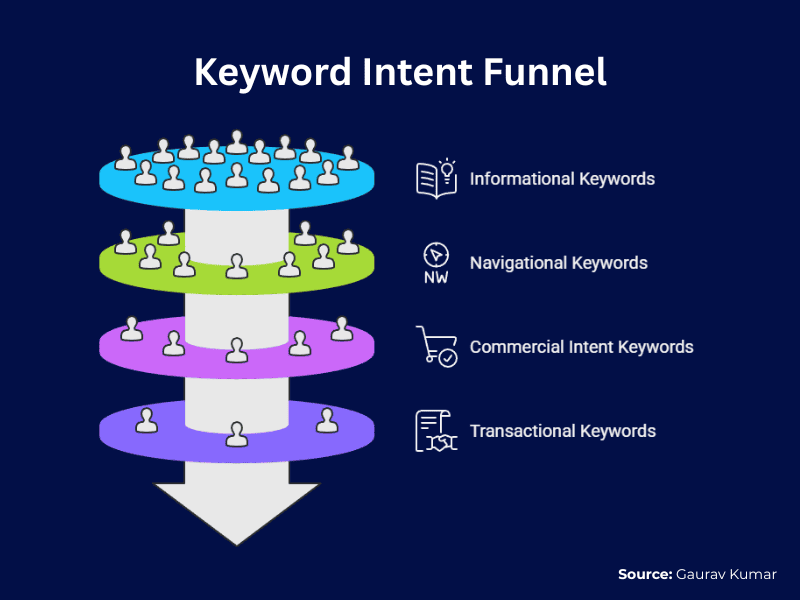
Think of keywords like a ladder. People start at the bottom when they’re just curious and climb up as they get closer to buying.
Informational Keywords
These are searches like “what is SEO” or “how does digital marketing work.” People using these terms are just starting their research. They’re not ready to buy anything yet. These keywords get tons of searches, but they rarely lead to sales. Sure, write some content for these terms to build your reputation, but don’t expect them to pay your bills.
Navigational Keywords
These are when someone is looking for a specific website. Like “Facebook login” or “Semrush dashboard.” Unless you’re a huge brand, these don’t really matter for your business.
Commercial Intent Keywords
These are searches from people who are actively shopping around. They’re typing things like “best SEO tools,” “top digital marketing consultants in Austin,” or “Semrush vs Ahrefs.” These people are creating a shortlist and checking reviews. They’re comparing prices and features. They’re close to deciding. These keywords are gold because you can convince them to choose you if you show up with the right information.
Transactional Keywords
These searches scream, “I’m ready to buy now!” People are typing “hire SEO consultant,” “book marketing consultation,” or “SEO consultant for conversions.” When you rank for these terms, you’re putting yourself in front of someone with their wallet already open.
Here’s a real example: Someone searching “what is SEO” might just be curious. But someone searching “hire digital marketing consultant” is ready to sign a contract today. Same topic, completely different intent, massively different conversion rates.
The key insight? A keyword with 100 searches per month that brings you ready-to-buy clients is worth infinitely more than a keyword with 10,000 searches that brings curious browsers.
High-Intent Keywords Change Everything
Let me paint you a picture. You rank for “digital marketing tips” and get 500 visitors this month. Maybe 2 of them contact you. That’s a 0.4% conversion rate.
Now imagine you rank for “hire digital marketing consultant for small business.” You only get 50 visitors, but 3 of them book a call. That’s a 6% conversion rate. Same effort, way better results, and you made more money with less traffic.
This is why buyer intent keywords matter so much. They filter out the window shoppers and attract people who are actually ready to spend money.
Plus, here’s a secret most people miss: High-intent keywords often have less competition. Everyone’s fighting over those big, popular search terms. Meanwhile, the keywords that actually make money are sitting there waiting for someone smart enough to target them.
When someone searches for “hire SEO consultant for conversions,” they’re not just browsing. They already decided they need help. They already decided they’re willing to pay for it. They’re just choosing who to hire. If your website shows up with the right message, that client is yours to lose.
Find Buyer Intent Keywords
Now let’s get into the practical stuff. Here’s exactly how to find keywords that will actually grow your business.
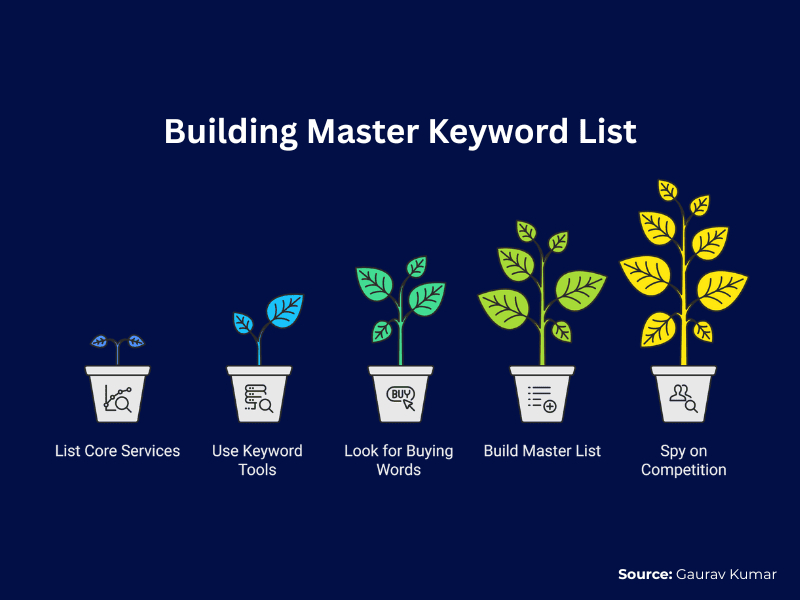
Step 1: List Your Core Services
Write down what you actually do and what people would hire you for.
If you’re a digital marketing consultant, your list might include:
- SEO services
- WordPress Development
- PPC management
- Content marketing
- Marketing strategy
- Social media marketing
These are your seed keywords. They’re the foundation you’ll build on.
Step 2: Use Keyword Research Tools
You need tools for this. Trying to guess which keywords people use is like shooting arrows blindfolded.
The best tool for this is Semrush, and here’s why: It automatically tells you the search intent for every keyword. This saves you hours of manual work.
Open the Semrush Keyword Magic Tool and type in one of your seed keywords. You’ll see thousands of related keywords pop up.
But here’s the crucial part: Look at the “Intent” column. Semrush search intent shows you exactly which keywords are informational, commercial or transactional.
Click the filter button and select only “Commercial” and “Transactional” intent. Watch all those time-waster keywords disappear, leaving you with only the money-makers.
For example, if you put in “SEO consultant,” Semrush keyword intent filters will show you gems like:
- Hire an SEO consultant (transactional)
- SEO consultant for conversions (transactional)
- Best SEO consultants (commercial)
- SEO consultant vs agency (commercial)
These are the keywords that bring clients, not just visitors.
Other useful SEO keyword research tools include:
- Ahrefs: Great for seeing what keywords your competitors rank for
- Google Keyword Planner: Especially useful for PPC keyword research if you want to run ads
- Ubersuggest: Good free option if you’re on a tight budget
Step 3: Look for Buying Words
Even without fancy tools, you can identify buyer intent keywords by looking for specific words that signal someone’s ready to buy.
These magic words include:
- Hire (hire SEO consultant, hire marketing expert)
- Buy (buy SEO services, buy consultation)
- Best (best digital marketing consultant)
- Top (top SEO agencies)
- Cost (SEO consultant cost, marketing services pricing)
- Quote (get digital marketing quote)
- Consultant (PPC consultant, marketing consultant)
- Services (SEO services, marketing services)
- Comparison words (vs, versus, compared to, alternative to)
Take your seed keywords and combine them with these modifiers. “SEO” becomes “hire an SEO consultant.” “Digital marketing” becomes “digital marketing services cost.”
Do this systematically for each of your services, and you’ll build a solid list of buyer intent keywords.
Step 4: Build Your Master Keyword List
Now organize everything you’ve found. Create a spreadsheet with these columns:
- Keyword
- Search volume (how many people search it per month)
- Difficulty (how hard it is to rank)
- Intent type (commercial or transactional)
- Priority (high, medium, low)
Your list of buyer intent keywords should focus on terms that have:
- Clear buying intent (commercial or transactional)
- Reasonable search volume (even 50-100 searches per month is fine)
- Difficulty you can actually compete with
- Direct relevance to your services
A keyword with 50 monthly searches that brings you 2 clients worth $5,000 each is better than a keyword with 5,000 searches that brings you nothing.
Step 5: Spy on Your Competition
Want to know what’s already working? Look at your competitors’ websites.
Use the Semrush Organic Research tool to enter a competitor’s domain. You’ll see every keyword they rank for. Filter by commercial and transactional intent and boom, you’ve got a list of proven keywords that are already bringing them business.
Look especially for keywords where they rank in positions 4-10. These are opportunities where you could potentially outrank them with better content.
You can also use this to find SEO keywords of a website you admire. If someone in your industry is crushing it, see what keywords are driving their traffic, then target those same terms with even better content.
Content That Converts Commercial Intent Searches
Commercial intent keywords need a specific type of content. These searchers are comparing options and researching before they buy. Your job is to help them decide while positioning yourself as the obvious choice.
What Makes a Keyword Commercial
Commercial keywords show that someone’s in evaluation mode. They’re looking at multiple options and deciding which one fits their needs best.
Examples include:
- best SEO tools for agencies
- Hire a digital marketing consultant vs an agency
- Top email marketing platforms compared.
- Semrush vs Ahrefs for keyword research
Notice the pattern? Words like “best,” “top,” “vs,” “compared,” and “review” signal commercial intent.
Creating Content People Actually Want to Read
For commercial intent keywords, create content that helps people make smart decisions. This includes:
Comparison Articles
That honestly evaluates different options. Don’t just say you’re the best, show why. Compare features, pricing and results. Be honest about pros and cons.
Detailed service pages
That explains exactly what you do, how you do it and what results clients can expect. Skip the vague marketing speak.
Case studies
Showing real results you’ve achieved. Numbers talk. “We increased organic traffic by 247% in 6 months” beats “We’re really good at SEO.”
Review-style content
That addresses common objections and concerns. What are people worried about when hiring someone like you? Answer those questions directly.
For example, if you’re targeting “hire digital marketing consultant,” your page should cover:
- What specific services do you provide
- Your experience and specialization
- Real results with actual numbers
- Your process step-by-step
- Pricing (or at least a range)
- What makes you different from other consultants
- Client testimonials
- Clear next steps to work with you
Make it stupid simple for someone to say, “Yes, I want to hire this person.”
Don’t Forget Local Searches
If you serve specific locations, local commercial intent keywords are goldmines. Someone searching “SEO consultant for conversions in Austin” is probably local and ready to meet.
Create location-specific pages for each area you serve. Optimise your Google Business Profile. Get reviews from local clients. Mention local landmarks and businesses in your content. This helps you show up for those valuable local searches.
Targeting Transactional Keywords
Transactional keywords are pure gold. These searches happen right before someone buys or books a service.
Recognizing Transactional Searches
Transactional keywords include action words that scream “I’m ready now!” like:
- Hire an SEO consultant.
- Book a digital marketing consultation.
- Get an SEO audit quote.
- Schedule marketing strategy call
- Buy SEO service.
- Order content marketing package
When someone types these, they’re not researching anymore. They’ve already decided to buy. They’re just choosing who to buy from.
Creating Landing Pages That Convert
For transactional keywords, blog posts don’t cut it. You need dedicated landing pages designed to convert visitors into clients.
These pages should:
- Have a clear headline that matches the search exactly
- Remove navigation distractions
- Focus on benefits, not features
- Include strong social proof (testimonials, logos, results)
- Have an obvious call-to-action above the fold
- Make contacting you ridiculously easy
- Works perfectly on mobile
For a page targeting “SEO consultant for conversions,” your headline might be “Hire an SEO Consultant Who Actually Drives Conversions (Not Just Traffic).” Then immediately show proof of specific conversion increases you’ve achieved for clients.
Don’t make people hunt for how to contact you. Put your phone number, email and a booking calendar right at the top.
Making Your Call-to-Action Match the Search
This sounds obvious, but most people get it wrong. If someone searches “book SEO consultation,” your button should say “Book Your Free SEO Consultation,” not “Learn More” or “Contact Us.”
Match your CTA to exactly what they searched for. This tiny detail can double your conversion rate.
Also, offer multiple ways to engage:
- Book a free consultation (low commitment)
- Get a paid audit (shows you’re serious)
- Schedule a quick call (easy first step)
- Download a useful resource in exchange for an email
Different people have different comfort levels. Give them options and you’ll convert more of them.
Advanced Tricks to Rank Higher for High-Intent Keywords
Once you know which keywords to target, you need to actually rank for them. Here’s how to optimize your content to beat the competition.
On-Page Optimisation That Works
Your target keyword needs to appear in specific places on your page:
- Page title and H1 heading (the big headline)
- Meta description (the snippet that shows in search results)
- First paragraph
- A few subheadings
- The URL, if possible
- Throughout the content naturally
But here’s what’s crucial: Don’t stuff keywords everywhere like a robot wrote it. Google’s too smart for that now. Use your keyword where it makes sense, then use related terms and synonyms throughout the rest.
Use a keyword optimization tool like Surfer SEO or Clearscope to check if your content has the right keyword density without overdoing it. These tools tell you if you need more keywords or fewer.
Adding Related Keywords Naturally
Google understands that pages about “hire digital marketing consultant” should also mention related concepts like “marketing strategy,” “ROI,” “growth,” “analytics,” “SEO,” “PPC,” and “content marketing.”
Include these related terms naturally throughout your content. This shows Google your page comprehensively covers the topic.
Semrush SEO Writing Assistant is perfect for this. It analyzes top-ranking pages and tells you which related keywords to include. Use it to make sure you’re covering everything searchers expect to find.
Schema Markup
Schema markup is code that helps Google understand your content better. It can make your listing stand out in search results with star ratings, prices and other details.
For service pages targeting commercial and transactional keywords, add:
- Service schema explaining what you offer
- Review the schema showing your ratings
- The FAQ schema answers common questions
- Local business schema if you serve specific areas
You don’t need to be a coder. Use schema plugins or tools that generate the code for you. This extra visibility in search results can significantly boost your clicks.
Building Keyword Clusters
Instead of optimizing individual random pages, create clusters of related content that work together. This establishes you as an expert and helps you rank for multiple related keywords.
The Hub and Spoke Strategy
Think of it like a wheel. Your main service page is the hub in the center, targeting a broader commercial keyword like “digital marketing consultant.”
Then create spoke pages targeting more specific transactional variations:
- Hire a digital marketing consultant for e-commerce.
- Fractional digital marketing consulting services
- Digital marketing audit and strategy
- Hire a marketing consultant for SaaS companies
Each spoke page links back to the hub and the hub links out to all the spokes. This structure tells Google you have comprehensive coverage of the topic.
Connecting Pages Strategically
When you mention related topics in your content, link to your other pages using relevant anchor text.
For example, if you have a blog post about SEO tips, link to your “hire SEO consultant” page with text like “work with an experienced SEO consultant” or “get professional SEO help.”
This creates a path from awareness content to conversion pages, guiding visitors through your site toward becoming clients.
Tracking What Actually Works
You can’t improve what you don’t measure. Here’s how to track if your high-intent keyword strategy is actually making you money.
The Numbers That Matter
Forget vanity metrics like total traffic.
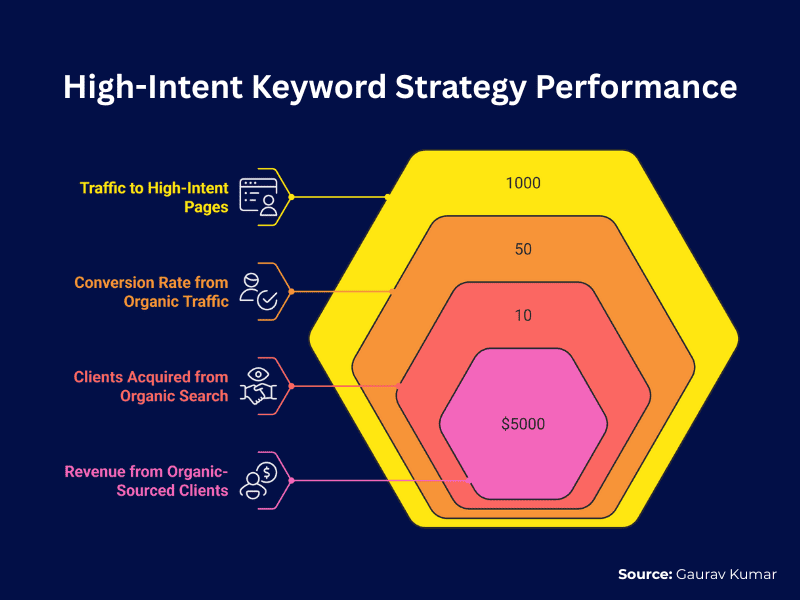
Focus on:
- Rankings for your target buyer intent keywords
- Traffic specifically to your high-intent pages
- Conversion rate from organic traffic
- Actual leads generated (form fills, calls, emails)
- Clients acquired from organic search
- Revenue from organic-sourced clients
Set up conversion tracking in Google Analytics 4 for every important action: form submissions, phone clicks, consultation bookings, email clicks and downloads.
Create a segment for traffic from your high-intent keywords so you can see their performance separately from your overall site traffic.
Keep Improving Your Keyword Strategy
Your keyword research isn’t a one-time thing. Markets change, competitors come and go and new opportunities appear.
Do this quarterly:
- Research new keyword opportunities
- Check your rankings for target terms
- Analyze which keywords are bringing you actual clients
- Double down on what’s working
- Cut what isn’t
Use Semrush’s Position Tracking to monitor your rankings automatically. It’ll alert you if you drop or improve for important keywords.
Pay special attention to keywords where you rank on page 2 (positions 11-20). These are low-hanging fruit. A little optimization work could move you to page 1 and dramatically increase your traffic and leads.
Test Everything
For your most valuable transactional keyword pages, run A/B tests to improve conversion rates. Test:
- Different headlines
- Various call-to-action buttons
- Form length and fields
- Page layout
- Trust badges and testimonials
- Offers and incentives
If your “hire SEO consultant” page gets 100 visitors per month and converts at 3%, that’s 3 leads. Improve conversion to 5% through testing, and you get 5 leads, a 67% increase with zero additional traffic.
Combining Paid Ads with Organic Search
While this guide focuses on SEO, combining organic rankings with PPC keyword research and ads creates even better results.
Learn Fast with Paid Ads
SEO takes time. You might wait months to rank organically and see if a keyword actually converts. Google Ads gives you instant data.
Run small test campaigns on your high-intent keywords. Within days, you’ll know:
- Which keywords actually convert
- What messaging works best
- Which landing pages perform well
- The real commercial value of each keyword
Use this data to prioritize your SEO efforts. If a keyword converts great in paid ads, make it a priority for organic rankings too.
Use keyword research and strategy with Keyword Planner to discover new opportunities and see actual search volumes before committing to long-term SEO work.
Dominating the Search Results
For your most valuable transactional keywords, appear in both the paid ads and organic results. This doubles your visibility and credibility.
When someone searches “SEO consultant for conversions” and sees your ad at the top plus your organic listing below, you look like the dominant player in your market. They’re way more likely to click one of your listings over a competitor who only shows up once.
This combined strategy captures prospects whether they prefer clicking ads or organic results, giving you maximum coverage.
Mistakes That Kill Your Results
Even smart marketers make these mistakes. Avoid them and you’ll get better results fast.
Chasing Big Numbers Instead of Real Results
The biggest mistake is targeting keywords based solely on search volume. A keyword with 10,000 monthly searches but informational intent will bring you lots of traffic and zero clients.
A keyword with 50 monthly searches but strong transactional intent might bring you 3 clients worth $5,000 each. That’s $15,000 from 50 searches.
Prioritize intent over volume every single time.
Ignoring the Full Journey
While this guide emphasizes high-intent keywords (because that’s what makes you money), completely ignoring informational keywords is a mistake.
Some prospects will find you early in their research journey. If you provide value, then they’ll remember you when they’re ready to buy later.
Balance your efforts: Spend 70-80% of your time on commercial and transactional keywords and 20-30% on informational content that builds awareness and authority.
Picking Fights You Can’t Win
Even perfect high-intent keywords won’t help if the competition is impossible to beat. A brand new website can’t outrank established authorities for competitive terms.
Check keyword difficulty scores in Semrush or Ahrefs. If you’re new, target easier keywords first (difficulty under 30). Build authority and rankings there, then tackle harder keywords.
Mix easy wins with aspirational targets. This gives you traffic and leads now while building toward bigger opportunities later.
Take Action: Your First Steps
You now know more about high-intent keyword strategy than 95% of businesses. But knowledge without action is worthless.
Here’s what to do right now:
This Week
Create your list of buyer intent keywords using the methodology I showed you. Focus on commercial and transactional terms related to your core services.
This Month
Pick your top 3-5 highest priority keywords and create or optimize pages targeting them. Focus on transactional keywords first since they convert fastest.
This Quarter
Build out your full keyword cluster strategy with hub and spoke content. Set up proper tracking so you know what’s working.
Ongoing
Monitor your rankings, track your conversions and continuously refine your approach based on what actually brings you clients.
Remember, the goal isn’t to rank for thousands of keywords. The goal is to rank for the RIGHT keywords, the ones that bring you clients who are ready to pay you right now.
Stop chasing traffic for the sake of traffic. Start targeting buyer intent keywords and transactional keywords that actually grow your business.
The best time to start was yesterday. The second-best time is right now. Open up Semrush, find your first high-intent keyword and create content that converts visitors into clients.
Your future clients are searching for you right this moment. Make sure they can find you.