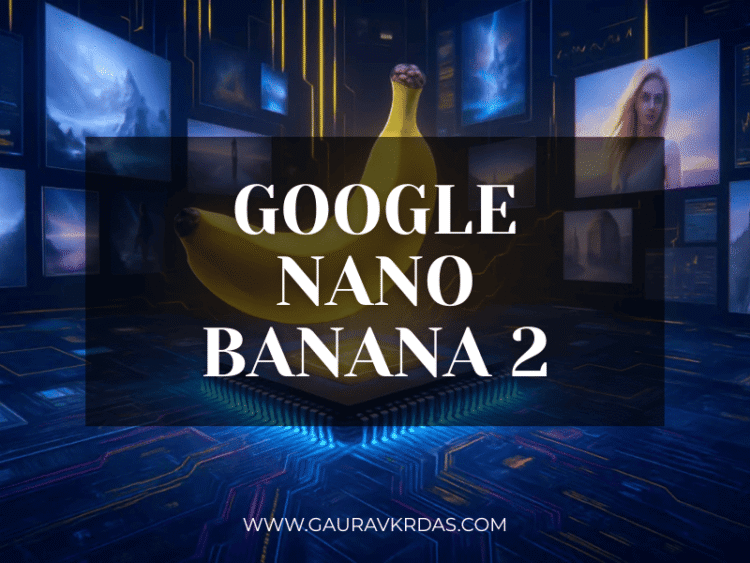
Google keeps trying new things, and always try to add new fetaures. The most recent version of their picture-generating program is Google Nano Banana 2, also referred to as Gemini 3.1 Flash picture. This potent new model is a huge advancement, combining the sophisticated features of its predecessor with previously unheard-of speed to enable anyone to create images of professional quality.
Understanding Nano Banana 2 and Its Significance
Google Nano Banana 2 started an exciting evolution in AI based visual content creation. Built on the foundation of Gemini 3.1 Flash Image technology, this model combines the sophisticated reasoning and world knowledge of the earlier Nano Banana Pro with lightning-fast processing capabilities. This idea is especially better because it doesn’t force customers to go for forgo quality in favour of quickness. Rather, it provides both at the same time.
The approach has been designed to support a variety of use cases within Google’s whole ecosystem. Nano Banana 2 offers versatility that meets practical image-generation needs, from marketing professionals creating campaign materials to content creators creating visual tales.
Key Features That Set Nano Banana 2 Apart
The technological advancements packed into Nano Banana 2 address many pain points experienced by users of previous generation models. Gemini’s advanced knowledge systems have fetaure of real-time web grounding. All this indicates that it can use current online data to produce more specific photos at any moment. Making data visualisations or infographics about popular subjects is quicker and more precise.
Text rendering is another specific enhancement. Professional designers and marketers oftenly face issues with AI-generated text present in photos. Nano Banana 2 provides clearer, more visible in-image text, as well as enhanced localization support for numerous languages. This single change allows you to create marketing brochures, greeting cards, and promotional graphics with confidence.
The model is very good at deciphering complicated instructions. Nano Banana 2 is highly accurate when it comes to understanding complex and multi-layered user prompts. Since it understands instructions better, the whole process feels smoother, you get from idea to final result quicker, without going back and forth too much.
Character and object consistency is a breakthrough in visual storytelling. Within a single process, the model maintains likeness between up to five different characters and fourteen separate objects.
Production-Ready Visual Output
Nano Banana 2 creates images that are clear and good enough for professional work. It can generate up to 4K quality and supports different aspect ratios, so it works for many types of projects. The images look better with more interesting sharper details, better textures, and more natural lighting.
Speed That Transforms Workflow
Perhaps the most transformational part of Nano Banana 2 is its speed. Google says the model is really fast. You can tweak things quickly or create different versions from the same idea without starting over. For marketing teams who are always racing against deadlines, that can save a lot of time, what used to take days can now be done in minutes. Efficiency increases result in lower expenses and more productivity.
Broad Integration Across Google Products
Google is not restricting Nano Banana 2 to a single use case. The launch covers Google Ads, the Gemini app, Google Flow AI Creative Studio, and Search AI Mode. Professionals from a variety of platforms can integrate it into their existing operations due to its accessibility.
Google AI Pro and Ultra members will still have access to Nano Banana Pro for specialized tasks currently, but on other side Nano Banana 2 will be the default model for new projects and daily use. This methodical technique promotes migration to the better new tool while guaranteeing backward compatibility.
Democratizing Advanced AI Capabilities
The big change since the release of Nano Banana 2 is the democratization of capabilities that were previously only available to seasoned users. The additional capabilities of the Pro model may now be advantageous to a larger audience due to its increased speed and accessibility. A few months ago, features like character consistency, real-time web interaction, and 4K output would have seemed revolutionary, but they are already commonplace.
Nano Banana 2 shows where AI is going and how its changing things. Now you don’t have to pick between speed and good quality, you can get both. As seen by its ability to appropriately balance complex characteristics with fast processing, future iterations of the model should continue to decrease processing times while increasing the number of options.
The Road Ahead for AI Image Generation
These days, the introduction of Nano Banana 2 represents the future of artificial intelligence. There is a tendency to have both speed and quality rather than concentrating on just one. As seen by its ability to appropriately balance complex characteristics with fast processing, future iterations of the model should continue to decrease processing times while increasing the number of options.
Businesses that depend on visual content, digital marketers, and creative workers have a strategic advantage with Nano Banana 2. Notable among these integrations is the one with Google’s advertising engine. Quick testing allows marketers to go for testing and to apply visual ad variants at scale, thereby increasing campaign success.
Conclusion: The Future of Creative Work is Here
The Google Nano Banana 2 is a superb example of how AI is still transforming the creative process. We are not aiming to eradicate human ingenuity or intelligence, but rather to augment it with ever-improving technology. Incorporating this into your marketing strategy makes creating advertising, infographics, and other visual storytelling much simpler, quicker, and more consistent.
Because it combines state-of-the-art reasoning, real-time information access, production-ready outputs, and lightning-fast performance, Nano Banana 2 is a true game-changer in AI-powered image synthesis. Marketing teams here hopes to gain a competitive edge through really fast, more intelligent visual content creation are likely to use this technology more frequently as it spreads throughout Google’s platforms.