Nearly 80 percent of the top 3 rankings shifted after Google’s March 2026 core update, and that single number tells you almost everything about where AI SEO strategy 2026 is headed. The sites that climbed were the ones built on real, lived experience. The sites that dropped were often well-written, factually correct, and still generic enough that Google pushed them down anyway.
After years of working in content and SEO, this is the first time I have watched the line between AI-generated and human-led content get sharper instead of blurrier. The common assumption was that AI would make everything sound the same and that search engines would eventually stop caring about the source. Instead, the opposite happened. Google got noticeably better at spotting the difference and started rewarding it openly.
Google has tweaked something every year for the past two decades, and the cumulative direction is obvious now. Search is moving away from typed queries and toward AI-generated answers, delivered through AI Overviews, Gemini, and similar tools. Most content online right now, across blogs and social platforms, is already AI-written, and that proportion keeps climbing.
A few years from now, AI-written content may become the internet’s default background noise, while genuinely human-written work turns into something rarer and more sought after, possibly even something people pay extra for specifically because a person wrote it.
Add to this the rise of AI agents that crawl, compare, and cite content on their own, plus people using AI to surface trends instead of browsing manually, and you get a future where AI is mostly talking to AI, with humans stepping in only at key decision moments.
This is why an AI SEO strategy for startups and small businesses cannot just be about churning out more posts. It all comes back to a framework Google has talked about for years but only recently started enforcing seriously, E-E-A-T, which stands for Experience, Expertise, Authoritativeness, and Trustworthiness. In this blog, I want to walk through what separates AI-generated content from human-led content and how businesses of any size can actually build visibility in this AI-first search world.
Why experience is now the deciding factor
For a long time, Experience was treated as the soft signal in E-E-A-T. Expertise and Authority got most of the attention because they felt easier to measure, things like credentials, backlinks, and domain authority. But after the March 2026 update, Experience became the main differentiator on competitive keywords.
From what I have seen, sites that added proper author bios with real names, real photos, actual industry background, and consistent bylines across their content saw real ranking improvements within weeks.
AI can write about a topic in a polished, accurate way. But it cannot say “I tried this for three months and here is what actually happened” because it did not try anything. That one line is what separates content that ranks now from content that does not.
The numbers tell the story clearly
I went through a bunch of recent data, and here is what stood out to me.
| What changed | The number |
| AI Overviews now appear on | over 60% of Google searches |
| Drop in organic click-through rate when the AI Overview shows up | around 61% |
| Sites with original data and firsthand experience | gained about 22% visibility after March 2026 |
| AI paraphrased content | lost about 71% of its traffic |
| The top 10 ranking content is also getting cited in AI answers | dropped from 76% to 38% |
Maybe I am reading too much into this, but that last stat feels like the most important one. Ranking on page one used to almost guarantee you would also show up in AI summaries. Now that the connection is breaking. Being well optimized is not enough anymore. You need to be the kind of source that AI systems trust enough to actually quote.
What an AI SEO Strategy 2026 for startups should actually look like
If you run a small business or a startup, I get why AI tools feel tempting. They are fast, cheap, and the output looks fine on the surface. But here is what I have learned the hard way. If your entire content engine depends on AI output with no human layer on top, you might see a quick spike, then a slow decline over the next few months. I have watched this happen with a few sites I track closely.
A better way to think about how to use AI in SEO without losing rankings is to treat AI as the first draft machine, not the final voice. Let it help with research, structure, and getting a blank page started. Then a real person needs to go in and add what only they know: a number from an actual campaign, a mistake that got fixed, a client reaction that was unexpected. That layer is what keeps the content alive when the next core update rolls through.
Is an AI SEO strategy enough in 2026, honestly
I’ll be honest, I use AI tools every day for research and drafting, so this isn’t an outsider’s take. AI can churn out content fast, sure. But it can’t make someone trust what they’re reading. Two years ago, that gap barely mattered. Now, in 2026, Google is quietly pulling those two apart, fast on one side, trusted on the other, and your content is already sitting in one of those buckets.
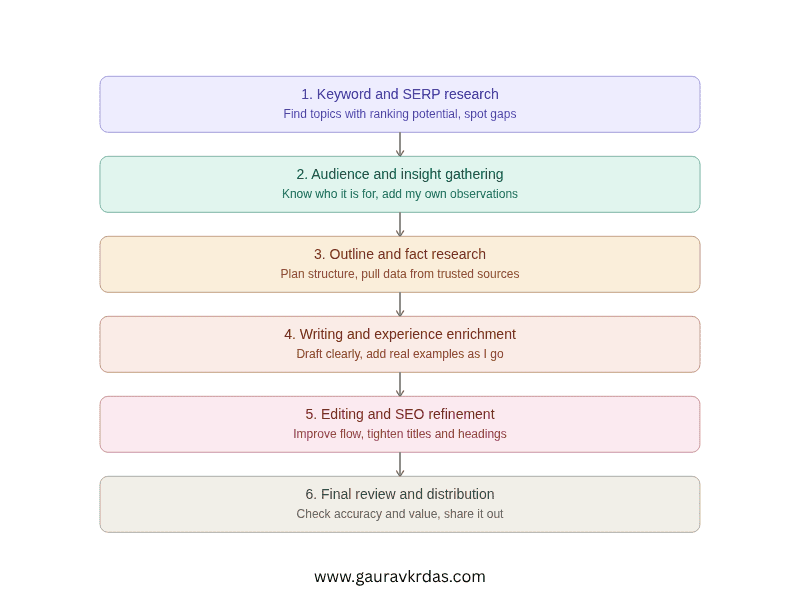
So when people ask me if an AI SEO strategy alone is enough, my answer is no, and the reason comes down to how I actually build content. Here’s my own process, step by step.
- Keyword and SERP research: finding topics with real ranking potential, then checking what’s already ranking to spot gaps I can fill
- Audience and insight gathering: understanding who I’m writing for and combining that with my own experience and observations
- Outline and fact research: planning the structure and angle while pulling data only from sources I’d trust myself
- Writing and experience enrichment: drafting with focus on clarity, and adding real examples and lessons as I go, not after
- Editing and SEO refinement: improving flow and readability, then tightening titles, headings, and on-page elements
- Final review and distribution: one last check for accuracy and value, then sharing it across the right channels
From what I have seen, the businesses still growing through search in 2026 are not the ones publishing the most. They are the ones whose content sounds like it came from someone who actually does the work, not someone summarizing what others have written about the work.
A few AI SEO strategy mistakes I keep seeing
Here are the mistakes that come up again and again, based on what I have reviewed across different sites:
- Publishing AI drafts with zero edits or added context, just to hit a content calendar
- Targeting broad, comprehensive keywords that AI can already answer well, instead of specific experience-based angles
- Skipping author information entirely, no name, no background, no consistency across posts
- Ignoring old content, only focused on publishing new pieces, while older pages quietly lose relevance
- Treating AI Overviews and traditional rankings as the same thing, when the data now shows they often do not overlap
Where I think the future of SEO with AI is actually heading
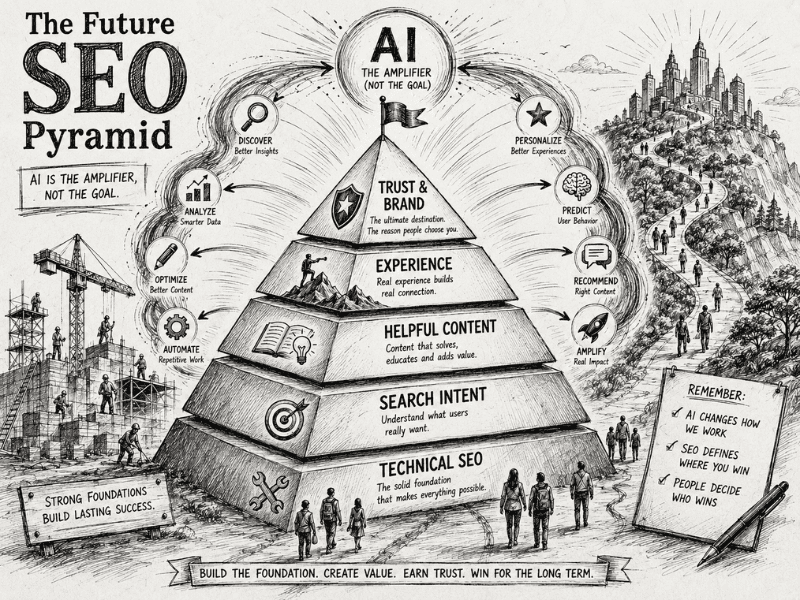
Content is split into two categories. One is the broad, comprehensive, everything you need to know article. Now it is becoming commodity content, because AI can produce a decent version of this in seconds, and Google knows it.
Then there’s the other kind of content, the kind that comes from something the writer actually went through. A result they got, a mistake they made and had to fix, and a real number pulled from an actual campaign they ran. This stuff is hard to fake, and honestly, it’s only going to matter more from here.
A few things I think matter most right now, based on what I have tried and what I am seeing work:
- Author pages with real names, real backgrounds, and consistency across every piece of content
- Original data, even on a small scale, like results from your own campaigns or projects
- Honest writing that admits what did not work, not just what did
- Updating old content instead of only publishing new content
- Structured information that AI systems can pull cleanly, such as tables, lists, and clear headings
Honestly, I don’t think the businesses that win the next few years will be the ones publishing the most content. They’ll be the ones whose content actually sounds like it came from someone who did the work. They’ll definitely use AI; that part isn’t going away, but they’ll use it to support their own thinking, not replace it. No copy-paste, no recycled angles, just their own context written in their own way.
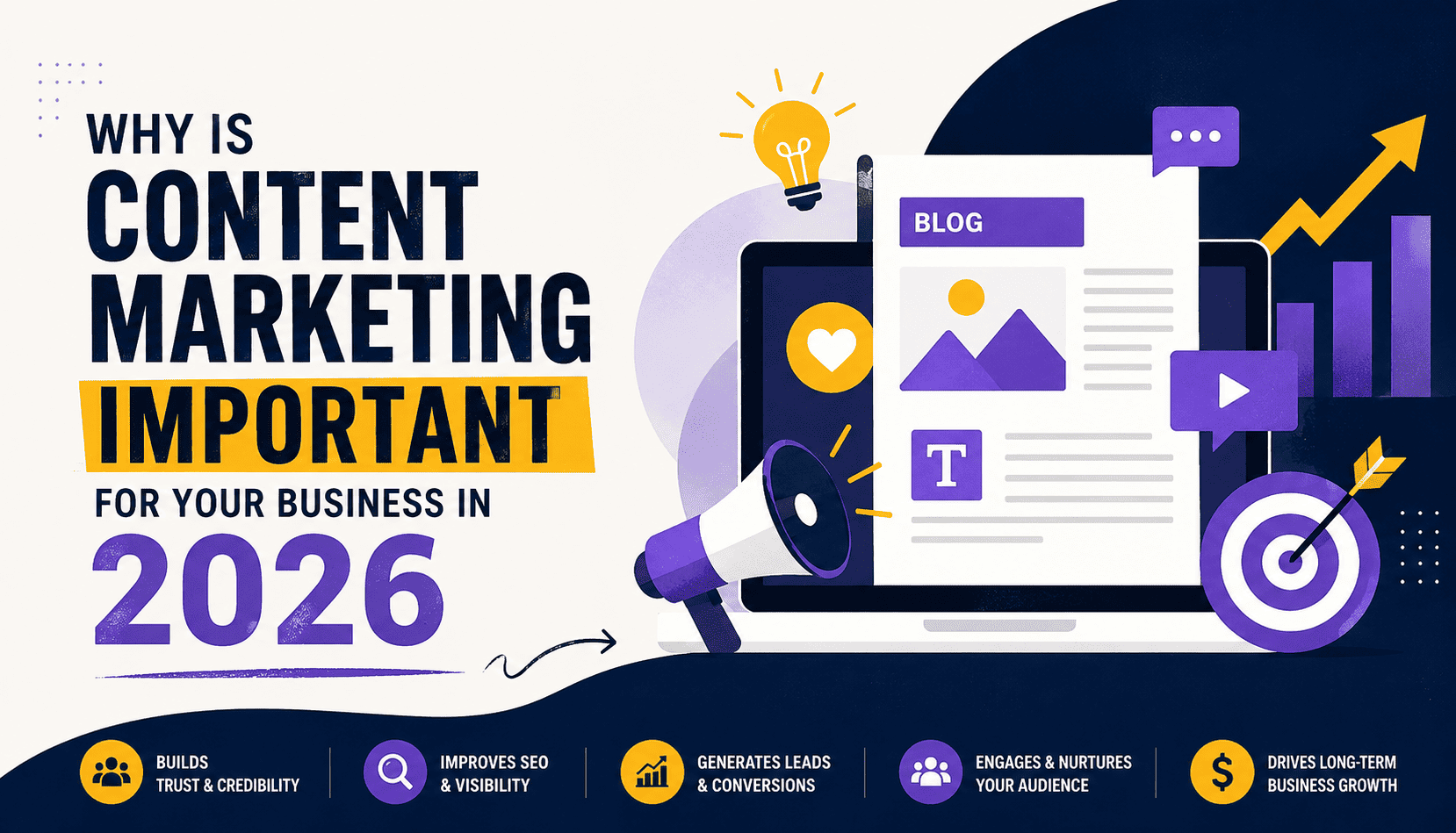
Read More: Why Is Content Marketing Important for Your Business in 2026
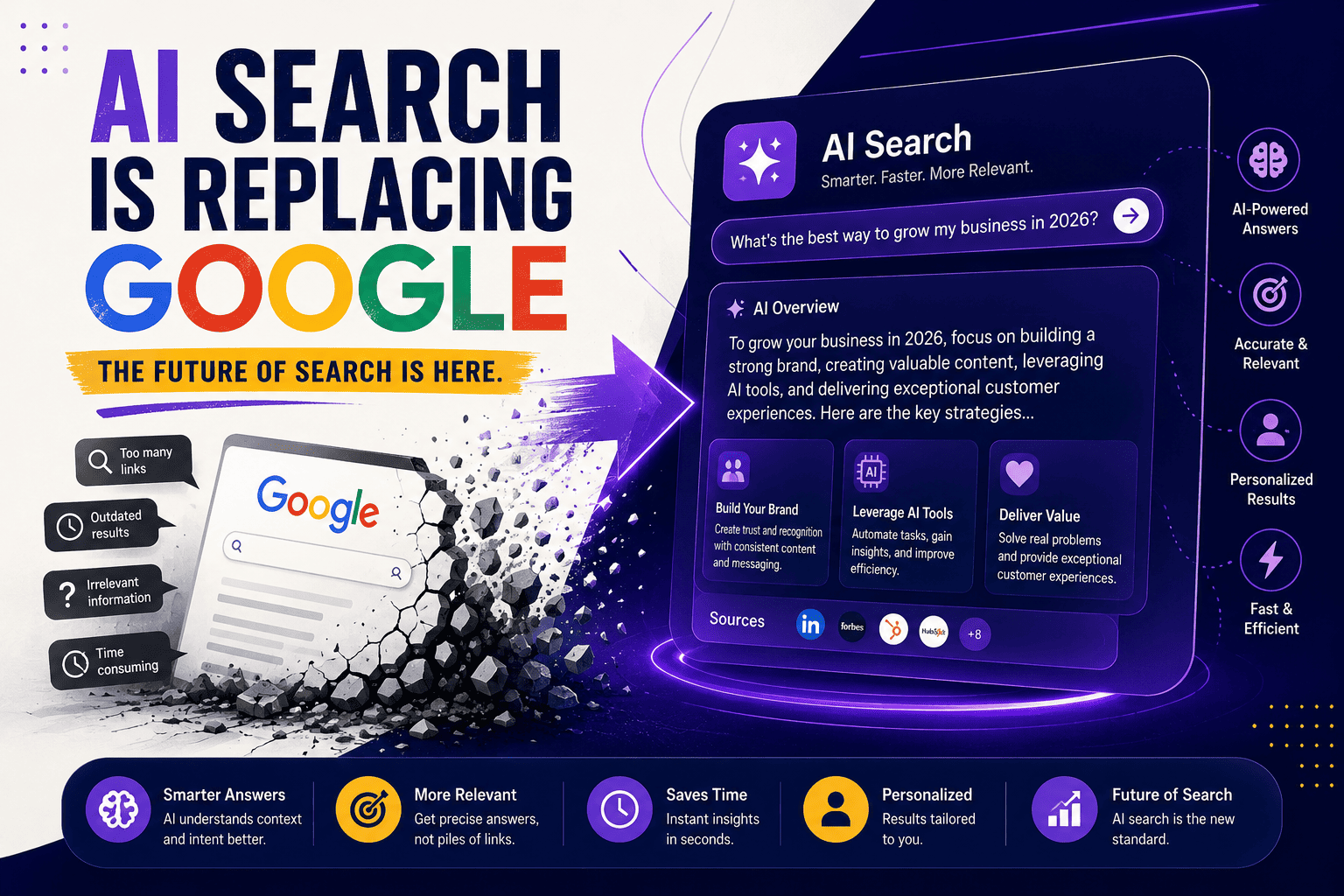
Read More: How AI Search Is Replacing Google (And What Small Businesses Should Do)
Smart businesses are also moving away from constantly publishing new content. Instead, they write something once, get it right, and keep it updated as things change. A 2025 Ahrefs study of 900,000 web pages found that 74.2 percent already contain AI-generated content, with only 2.5 percent being pure AI and the rest a human and AI blend. With AI-written content becoming the default, one honest, well-kept piece now stands out far more than ten rushed ones, and that’s what builds long-term trust in an AI-first search world.
A few quick questions I get asked a lot
Do I need to stop using AI for content completely?
No. Use it for research, structure, and first drafts. Just do not let it be the only voice in the room.
Will my old content lose rankings if I do not update it?
It is becoming more likely. The data from March 2026 shows updated, experience-rich content recovering faster after core updates.
Is keyword research still useful in 2026?
Yes, but it is shifting from chasing exact phrases to covering topics and answering real questions people actually have.